
FEAR
From the Titanic to a book on horse-powered work

I never wanted to write that (expletive) book.
The voice in the woman’s head was calm and reasonable.
In her bed, the woman again flopped from one side to the other. Her sheets felt too heavy and she kicked ferociously at them. She was aware she was scowling. She lifted her sleep mask and peered at her watch. Again. The time had advanced 22 minutes since the last time she’d checked. It was the witching hour: smack-dab between three and four in the morning.
The woman called this “the hour of the wolf,” when her personal demons and her Persecutor tended to show up ready to party. Tonight, instead of continuing to wrestle the bedclothes and disturb her bed partner, she decided to put her highly-therapized inner-personal skills to good use. She took off her sleep mask and removed her mouth guard. She looked out the open window at the dark and listened to wind in the ponderosa pine trees. She took a breath.
“Okay, I hear you saying you never wanted to write the book about horse-powered work.”
The voice was emphatic.
RIGHT. I never did.
“Why?”
Because it is a (expletive) stupid idea, that’s why.
“Can you tell me why you think it’s a stupid idea to write that book?”
The voice bore down like a mental drill press.
Because we don’t (expletive) know (same expletive) ANYTHING about the (same expletive) topic, that’s why. You complete MORON, what were you (expletive) THINKING when you signed that (same expletive) contract?
The woman sighed. Always with the cursing. The Persecutor-de-la-nuit was a big, fat potty mouth.
“You’re really afraid, huh?” she said.
In response, there was merciful silence. The woman nodded slightly, replaced mouth guard and eye mask, tucked in against the solidity and heat of her bed partner, and fell asleep.
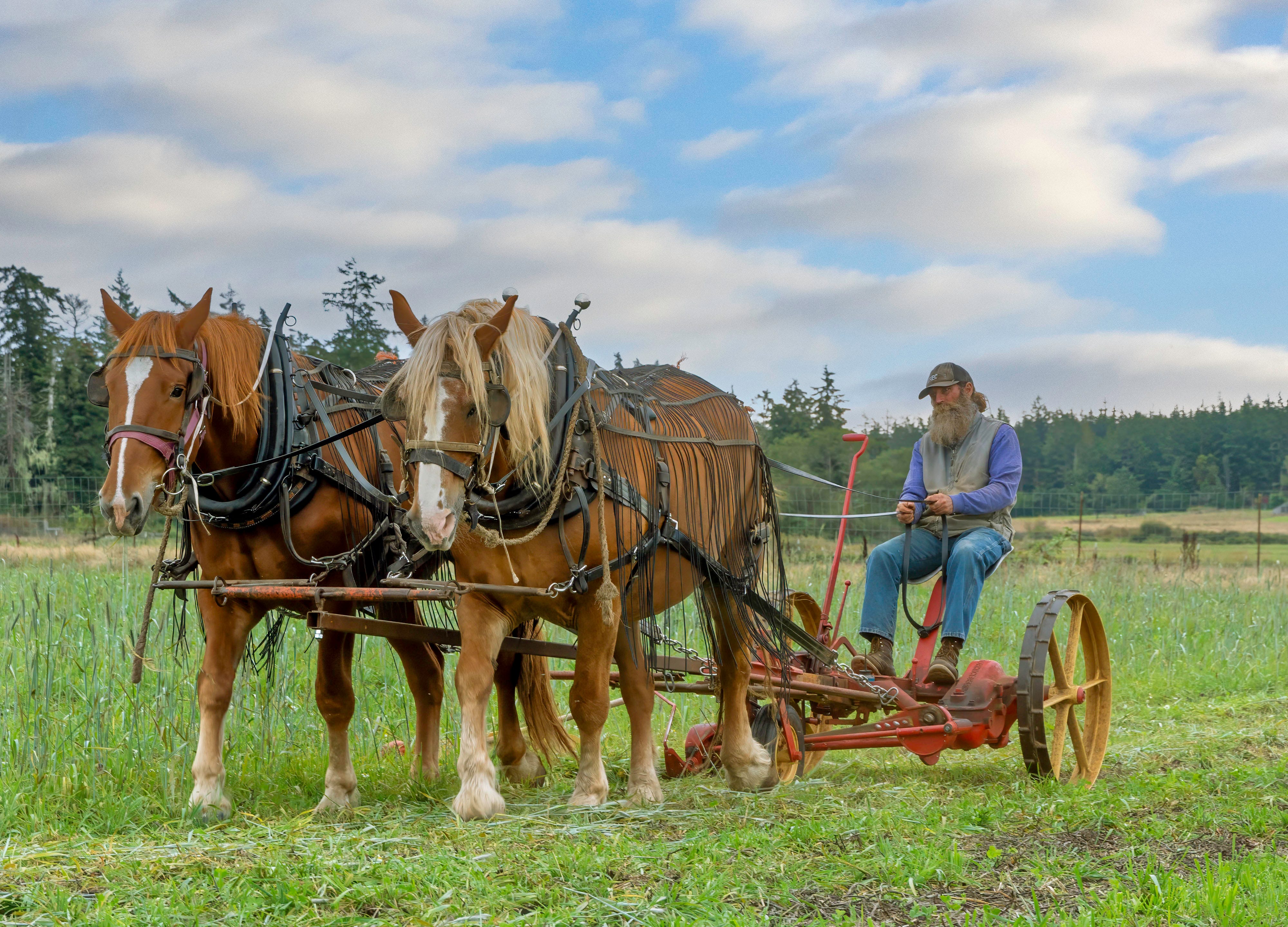
Excerpt from “Horse Drawn Farm” Eclectic Horseman Magazine, November/December 2025:
…they appear: four massive horses side-by-side, gold coats sweating under brown harness, flaxen manes flapping as heads bob rhythmically in time with their slow steps.
“Ho.”
The man on the harrow behind the team speaks calmly at the end of the long row. The horses stop. There is a pause, and in the quiet one can feel cool air and notice birds lift from the surround of nearby trees.
“Team.”
His hands on the lines seem motionless, but some invisible cue whispers to four equine mouths and, as a single unit, 16 equine legs begin a deliberate crossing sidestep to the right, dragging heavy machinery 90 degrees. The driver carefully aligns the team on the big square section and the equines step forward again. They are patient in their work. The driver is patient in his work. The scene speaks of a great and patient wisdom—that of human and horse working land to create food: slowly, deliberately.
“I mean, I got the dream, right? I had a publisher freaking offer me a contract to write a book about horse-powered work.” I flapped both hands irritably at my therapist. “So what the hell is wrong with me? Why won’t I do the work?” Why am I … terrified?”
Amanda’s eyes lit up with what a less-charitable person might describe as glee. In my opinion, your therapist never should look gleeful. But my therapist was, among other things, a former Army captain who got blown up doing two tours in Iraq. She’s deeply kind and just so tender…and she can curse like a stevedore and tends to get annoyingly, yes, gleeful when we’re circling in on some potent roadblock in my tender psyche.
“Let’s try some EMDR,” said Amanda.
She stood up and retrieved the instrument of torture, AKA the EMDR Bilateral Stimulation Device, from the shelf where it lurked like a spider. I rolled my eyes and made the kind of put-upon squinchy face a middle-schooler makes at the mention of homework.
“Any memory pop up when you think about your fear around this book?” Amanda asked, handing me the stupid little paddles that would buzz my palms and change my brain.
And the Titanic sailed majestically into the room.
EMDR (Eye Movement Desensitization and Reprocessing) is a massively potent therapy that “combines traditional talk therapy with bilateral stimulation (like side-to-side eye movement or tapping or vibration) to reprocess traumatic memories,” (according to the EMDR Institute). The spider device sends little pulses of current along two cords to small paddles I hold in each hand. The paddles briefly buzz my palms, left-right-left-right, as I work through a painful memory.
The therapy literally reprograms how you feel and understand a memory. I’ve used EMDR for decades to help me wade through my own personal Gollum’s Cave, which seems to be a never-ending treasure trove of beliefs and experiences I’ve stored up since childhood that trip me up in an adulthood I am striving to make as healthily functional as possible.
I believe in EMDR. I don’t exactly like the process, but it works.
When I was in sixth grade I had to Do A Report on Something I Found Interesting. I found the Titanic interesting. All those dead people and a ship that couldn’t sink but did and a band that played as the ship sank beneath the waves. Mind you, this was loooong before a certain movie made “I’m king of the world!” a catchphrase for both true love and doomed love, so there was exactly one book in the adult section of the Vacaville Public Library on the Titanic. It was an elderly hardback with a blue fabric cover. It had a few blurry, black-and-white photos. And it had really, really tiny print.
I was eleven, going on twelve. I had two weeks to do the report. I took the book home, cracked it open, looked at the blurry photos, and was stymied by the teensy print. There were just a ton of little words that were put together in the most uninteresting and incomprehensible fashion possible.
I put the book aside. I glanced at the thing periodically over the next two weeks, fear increasing, until the night before the report was due. Then I had a terrible and panicked afternoon and evening until a late bedtime, erasing and smudging with my bad cursive writing, using lined paper on which I skipped lines to make the report look longer than it actually was.
I got a terrible grade from a teacher who expressed dismay and surprise at my poor work. I got a talking-to from my maternal parent about doing my homework in a timely fashion. I got derision from my paternal parent, as apparently neither he nor any of my elder siblings had ever failed at schoolwork like I had.
And I got one hell of a mental Easter egg to find about fifty years later when “Do a Report on Something that Interests You” became “Write a Real Book (and get paid for it) about Something that Interests You,” and my psyche freaked out and ran screaming from the room.
So, on Tuesday past, Amanda and I revisited that memory and I felt all the shame and panic and dread and terror of my middle-grade self. I felt the pain of failure. It was easy to connect the dots between the Titanic report and what feels like a titanic project that is bearing down on me like a certain ill-fated ship bore down on an iceberg.
The magic of EMDR is you get a chance to rewrite the script of your hobbling memory. By the fourth or fifth pass of buzzy palms, I saw that what that eleven-year-old kid needed and did not have was help. She needed someone to teach her How to Actually Write a Report about Something that Interests You. So I offered my current expertise, which is substantial, about how to interview people and organize manuscripts and get sh** (expletive!) done. I pointed out all the many ways we have completed really difficult things, like getting two MFA degrees and finishing multiple written manuscripts.
And right at the end of my therapy session, onto the deck of the Titanic, which was miraculously righting itself in my psyche, two red-blonde Belgian horses hitched to a red mower began walking towards me, big hooves clopping against wood.
I started to laugh. Here was the image and reminder I needed.
What am I interested in? All things Horse. What captured me in that initial story for Eclectic Horseman Magazine, the story that gained the attention of Homestead Press and led to this book contract that was giving me hives—was humans and horses working together. I was fascinated by what that working relationship looked like, sounded and smelled like, felt like. What it was to work in partnership with an equine in harness?
I need to work with Horse to develop this book manuscript. I need to learn from people who love to drive horses and work in partnership with them. I need to remember and create that one word the Lopez Island farmer used to bring together the power of thousands of pounds of horse muscle, four equine brains, and a human desire to grow food. It’s a simple, powerful word:
Team.
If you are a teamster or work with horses in harness—or if you know someone who uses equines for horse-powered work of any kind, please message me. All leads are welcome—and thank you.
TO THE HORSE!
Right away I knew who you were talking about.
Fear is a built in feature of the human condition. This is something we project on our horses as much as they have it built in too.
Get acquainted with fear to know it better .
Learn to use it and your life will be better. Make friends with it to be free.
Fear in humans fascinates me. I see it everywhere, in everything. It affects us down to the smallest things we do, it is insidious.
That said, thank you for your post and glimpse into your life.
Love your writing .
🙏❤️
“Team” is almost the hinge word. The horses move as one body, guided by a subtle human cue, turning 16 legs and heavy machinery with patient precision. That becomes the model for recovery: not forcing the book alone, but working in partnership with memory, skill, therapy, subject matter, and Horse itself.