
Iberian
Learning from Lusitanos in Portugal

The gray Lusitano mare waddled slowly up to me, ears back. Her belly was huge; her udder swollen but not yet with the waxy teats that said she was going to foal in a day or so. She stopped with her shoulders next to me, so I reached up to scratch at her roached mane. She adjusted herself so my handy fingers were positioned a few inches in front of her withers, clearly the preferred place, and I obligingly dug in. Her ears relaxed as she swung her head back and forth, upper lip extended in an expression of horsey pleasure.
Someone bumped my shoulder and I turned to find a younger bay mare in close proximity. She nosed my shoulder again. What are you doing? I placed a soft finger on the joint of her jaw and held it with one hand while I continued scratching the gray with the other. A bay foal with a broad blaze pushed in next to his mama and pulled at my shirt with his teeth. I looked over the back of the gray mare at the slowly jostling herd of Lusitano mamas and babies waiting at the gate for their morning grain. It was six a.m. on my last day at Monte Velho. I was surrounded by horses and simply happy.
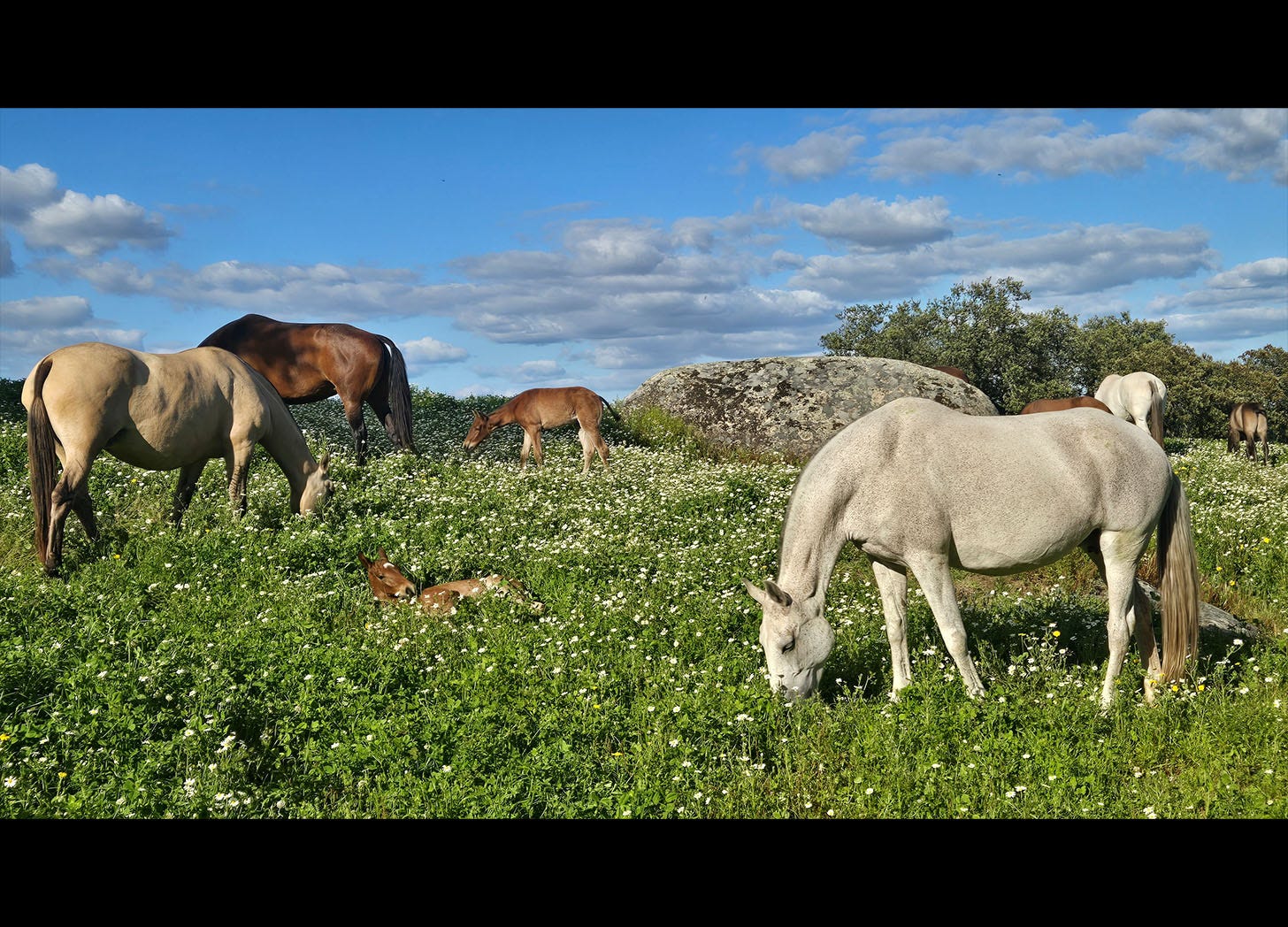
Both mares simultaneously began to yawn as the bay had a release from the simple Masterson Method technique I’d done on her TMJ (temporomandibular joint). I stepped away from the mouthy youngster and sighed. It is not often I get to stand within a herd of mares and foals, but that is what happens—or can happen—when I go to Portugal to ride Lusitano horses and improve my equestrian skills.
Portugal is a small country with a huge history. Part of the Iberian Peninsula—which on a map looks a bit like a large hoof below the fetlock of the Pyrenees mountains in Europe—Iberia is dominated in size by Spain, but Portugal, which lies on the western side of the hoof, is specifically its own self: beautiful, opinionated, passionate, and full of horses named after Lusitania, the Roman name for the region modern Portugal now occupies.
Lusitano horses are also remarkable in their particularities. Cave paintings show horses were present on the Iberian Peninsula some 25,000 years ago during the early Neolithic period. The Phoenicians and the Celts crossed the ocean blue to Iberia, bringing their own horses along and bred with local stock to develop war horses that in 370 BCE Xenophon wrote of with admiration. The Mediterranean was a battleground for centuries, and those horses played an oversized role in the successes and failures of the epic turns of fortune in kings and countries. Waves of Roman conquests led to the establishment of Iberian horse stud farms up and down the Peninsula.
Then from the south came Muslim conquerors with Barb horses—which they bred with the Iberian stock, producing the war horses that became the “Horse of Kings,” beloved of European monarchs for hundreds of years.
Despite the fact that Portugal and Spain were ferociously at odds with each other for centuries, with the latter constantly seeking to dominate and subdue the former, for the most part the Iberian horse was simply known and understood as one breed, with individual regions gradually claiming differentiation. The Lusitano takes its name from Lusitania, as I mentioned above. Some say the Lusitano is genetically identical to a breed that was named after the Andalusian region in Spain. (Please don’t rage at me, Lusitano and Andalusian horse owners. I’m just reporting here.)
Despite the best efforts of the Spanish in the 1600s to eradicate cavalry horse breeding in Portugal, the stubborn little country kept developing its own horses and in the mid-1960s the Portuguese Lusitano stud book was separated from the Spanish Andalusian stud book and permanently closed, with each country taking on differing breeding objectives. The Lusitano horses I have had the pleasure of working with for two weeks each April for the past three years are—well…they are just lovely in all ways.
What a horse! Bred for war, bred for bull fighting and the management of cattle on ranches, bred for the “high schools” of dressage that flourished in Europe during the 1700s, the Iberian horse was and is somehow also temperamentally steady, friendly, and inclined to look after its person. They are physically agile, muscular, intelligent, and kind.
The Lusitano is named as a Portuguese national treasure.
After more scratching and again disentangling a curious baby mouth from my clothing, I eased away from the mares and foals and walked down a dirt road into a spring Portugal early morning of green pastures dotted with red clover and white daisies. I walked slowly. I was tired after two weeks of twice-daily dressage lessons, with groundwork lessons added into the mix this year.
I’d returned to Portugal three times. There was something about the country that called me to hop on a plane, fly across multiple time zones and endure ugly jet lag in order to find myself in the Mediterranean, which felt and looked much like the Northern California landscape I grew up in, with oak trees, rosemary and lavender, low rolling hills, and an ocean proximal.
And there was a lot to be said, for a person intent on developing herself as the best rider she could be, in taking a deep dive into dressage and studying with Lusitano schoolmasters who have been trained to understand and perform Gran Prix moves.
A “schoolmaster” horse is a rare and wonderful equine which is patient, kind, and disinclined to pitch you off of its back when you transgress in your aids or requests. Schoolmasters are rare, except, it seems, in Portugal, where the training and temperament of the breed seem to make even younger horses willing to allow a less-competent rider to experience the glorious feeling of flying changes, piaffe, passage, and pirouette.
Riding involves learning through feel, and riding a trained schoolmaster is a fast way to improve feel and understanding, and trot home with better skills. Going to Portugal and riding intensively for two weeks inevitably improved my seat, timing, aids, and understanding. I was lucky to be able to afford this, I knew.
Lusitano horses have slightly convex or Roman noses. Their necks are thick and arched; their shoulders and chests are broad, with short backs and sloped croups. They have deliciously thick manes and tails. They are inclined towards people, which makes us feel noticed and special. This is like handing candy to any horse person.
Due to a tricky little mutation in color genes which was passed down from their ancestors, most Lusitanos change color as they age, with bay, black, or brown babies turning white over time. About 80 percent of Lusitanos have this mutation. The gray broodmare I’d been scratching had been born a bay, with reddish hair and black legs. I could tell she was probably around 15 years old because her coat was white, with subtle small flecks of brown speckling her hide.
I turned and looked back up the hill to the herd of broodmares and babies. A shifting, jostling mass of horses being horses. That herd had the run of 50 acres of fields, oak trees, and a small lake to drink from and wade in. I loved to watch them each morning.
As I continued my walk up the road that would lead me on a hourlong hike back to the stables and accommodations at Monte Velho, I wondered why, this year, I was restless and had felt unable to drop into the experience as fully as I had the two previous years.
I’d spent one week at the Valença Equestrian Academy outside of Lisbon, then come to Monte Velho, which offered much more of a resort experience. I’d ridden ten different Lusitanos, each similar in exceptional training, and each unique in personality and style. I’d had twenty riding lessons and seven groundwork lessons. I should have been relaxed, happy, and extremely pleased with myself. I had been riding at the top of my current ability. I’d received praise and direction and encouragement.
What I felt was tired and a little glum, so I walked the sunrise and thought about Iberian horses. Then I thought about one particular Iberian horse specifically. My mare Willa is an Iberian, but Andalusian, not Lusitano. Willa was born a bay, and is now dappling into white. Willa, my light, my joy and my challenge, awaited my return. (My girl had spent the two weeks I was off gallivanting on Lusitanos with a trainer friend who ponyed my green mare out on trails behind her stolid and dependable Mustang gelding every day. They had camped overnight in the mountains. Willa had walked literally over hill and dale in Oregon while I daily explored the flat expanses of dressage courts in Portugal.)
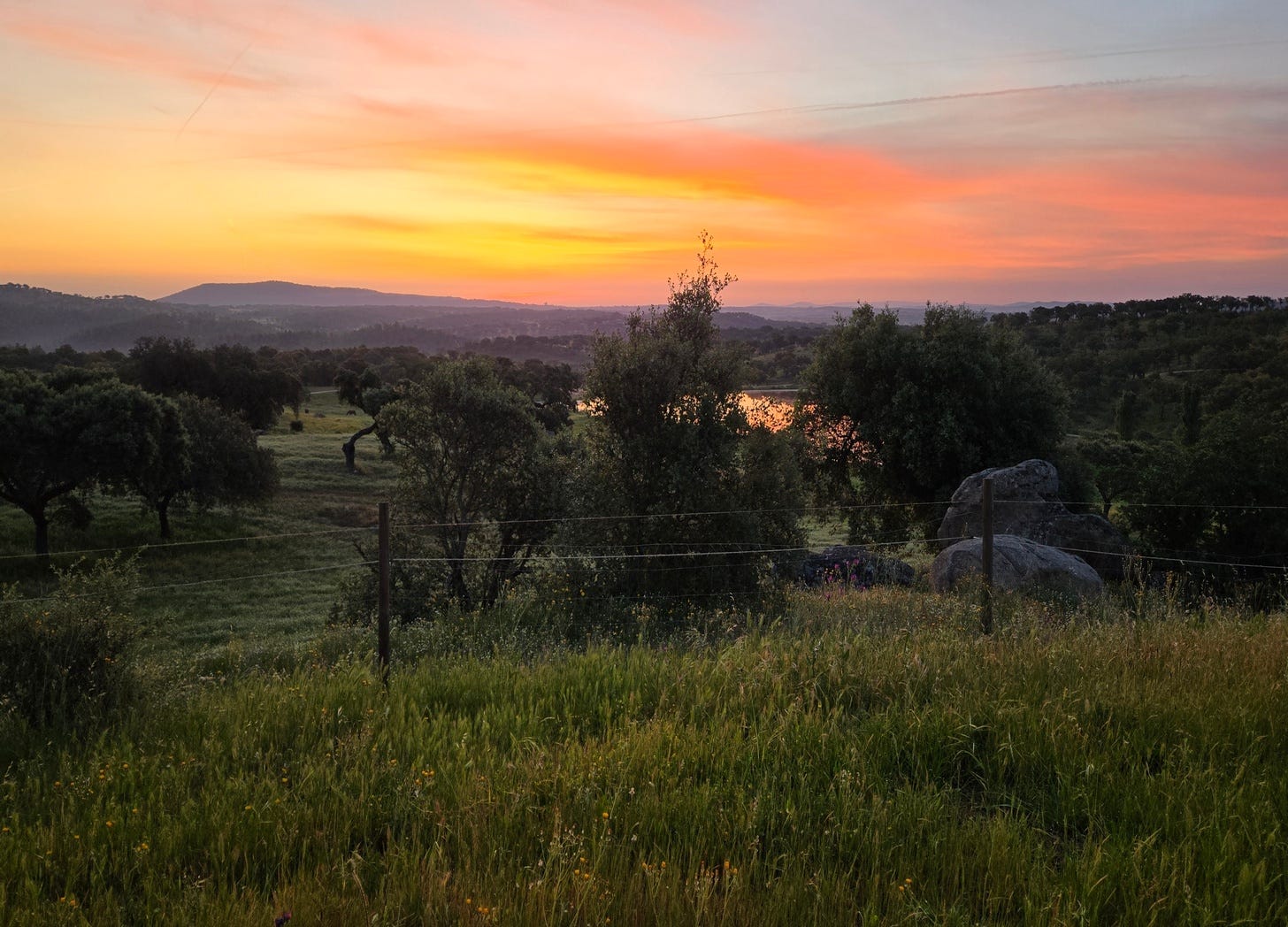
As sun made the horizon bloom, I realized the difference between the two previous trips to Portugal and the trip this year was the relatively-new fact of my own Iberian horse in my life. I also realized that as much as I want to become an upper-level dressage rider, as much as I loved my time with Lusitano horses in Portugal, what I really wanted was to work with my own Iberian horse. I suddenly understood I knew enough, rode well enough today to develop (with help) my Iberian horse in her strength, her balance, her agility, her confidence. Whatever Willa chose to delight in—be it trail riding or dressage or working equitation or liberty or some admixture of everything—I knew I no longer needed the Lusitano schoolmasters to point the way.
I stopped at the top of a hill and surveyed the surround. Portugal, lovely and forever beloved, spread out in cork forests to the horizon. I thanked her for her treasures of place and graceful people and those fantastic Lusitano horses.
Then I turned and pointed my face eastwards towards home, where a gray Iberian mare waited to share the journey.
That said, if you like the writing and want to support horses, you might want to join our Prodigious Pledger Herd. Every dollar you pledge will go directly in support of an organization that supports horses. We choose the organization in November and donate our hard-earned dollars in December of each year. You can check out my Substack About page for more information and to see a list of each year’s donations.
I love to hear from you, so feel free to give me a shout by clicking the “Message Katrina” button in the app or online. It might take some time, but I promise I will respond.
Thanks for being a Substack reader.
TO THE HORSE!
Lovely read :) I spent a year training in Portugal and had a chance to visit Valença's place when on a horse buying trip. The centre I worked for was expanding their horse power and we tried some horses at Valença's. I remember getting on one of them and not being able to stop smiling from beginning to an end of the test ride. I have never before and never since ridden a horse that was trained to such lightness, responsiveness and felt so in-tune with a rider he never carried on his back before. I seek to develop that feel (or at least a fraction of it) in every horse I work with now. (the centre did end up purchasing him :) ) . All the best with Willa :)
Beautifully described. Willa is lucky to have you. 💕🐴💕