
OK
Okay?

Note: My Tech Guy (Steve) is off on a photography adventure, so there’s no recording of this post. I will have to learn how to record without him! Someday…
“How are you doing?” I asked, as I entered the studio.
“I’m okay,” my massage therapist said. Her face skin was tight. Her hands came up in a reflexive, pushing-off gesture. Her whole body said: I am not good. I am holding it together, but I do not want to talk about it.
I felt myself flood with sorrow. Just weeks earlier her partner had left her. I nodded and walked towards the massage table, placing her in a field of light as I passed.
“Okay” is a potent word in the English language. It can indicate approval or agreement. It can show acceptance or assent. It’s an acknowledgment. It can also be a sign of indifference.
My massage therapist meant her “okay” to indicate a state of adequacy. Her leg had not been cut off and she was not spurting blood. She was alive, but not thriving. Just… okay.

What is fascinating to me about “okay” is how humans use that one word to mean so many different states of being-ness. We are all pretty dang adept at instantly sussing out what is meant by any given “okay” and responding appropriately.
The other day Steve challenged me to do some dumb, mundane task around the house I’d been putting off for weeks but which he needed me to get done before he could proceed with another housely task that he wanted to complete prior to leaving for a photography tour of Utah.
I knew I needed to do the thing. I knew I had been putting it off. I knew his request was totally and completely fair. Nonetheless I felt grouchy and put-upon.
I bared my teeth in a false grin, cocked my head, widened my eyes, gave him a double thumbs-up and said, “Okaaaaaaay!” with all the false enthusiasm I could muster. I was ridiculous. I knew it. We both burst out laughing.
“Okay” can be sarcastic. It can be a rude bully. It can be a co-dependent little whiny baby of a query. “Okay” seems to be something of a chimera, not really indicating its true self, and this probably has to do with its origins, which are a bit shady.
Some digging into the etymology of “OK” reveals the term became popular in the mid-1800s in America. It might be an acronym for “Oll Korrect,” a facetious alteration of “all correct.” Or “OK” was an acronym for “Old Kinderhook”, a nickname for Democratic president Martin Van Buren, a native of Kinderhook, New York. The term took off in national newspapers, and “OK” became a colloquialism for “all right.”
But... some say the term “okay” originated from the Choctaw “okeh,” meaning “it is so.” Still others point towards a West African influence, with “kay” as in “Yes, indeed” nudging into the mix that became “okay.” Still others think that the Scottish, “Och, aye” (“Oh, yes) is a parent of “okay,” and even the Greek phrase όλα καλά (óla kalá), meaning “All good” might have played a birthing role in the simple word.
English is famous for adopting loaner words. “Déjà vu” (French), “sushi” (Japanese), and “karma” (Sanskrit) are some examples. But “OK” has shades and flavors those terms lack. “Okay” often means anything but “all right.” “Okay” often indicates what I would describe as a certain hidden brace underneath. A sense that things are not, in actuality, okay at all.
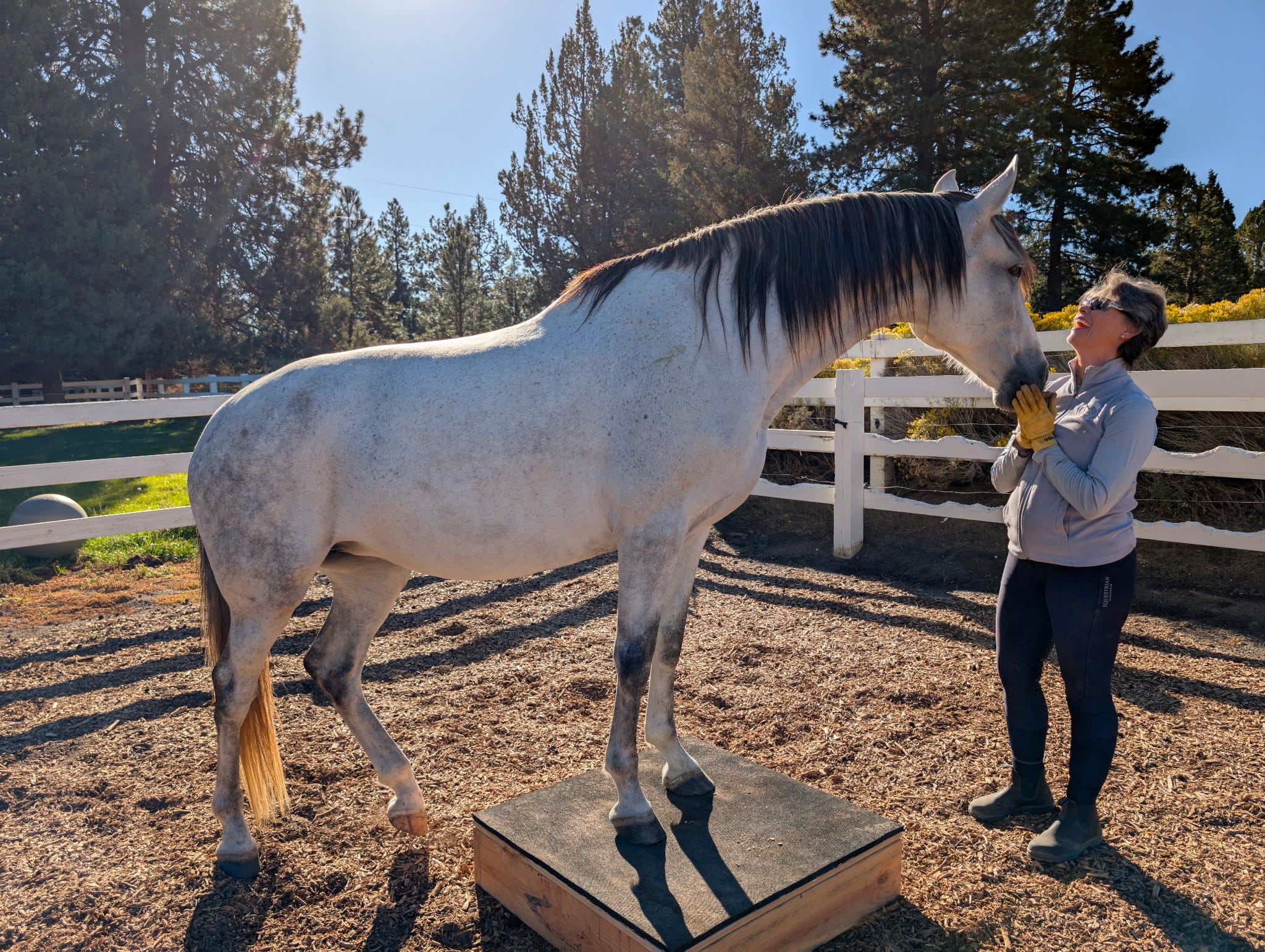
Four months ago Steve and I welcomed a new member into our family of two. Willa H is a seven-year-old Andalusian, come to Bend, Oregon by way of Austin, Texas. She is lovely and so very smart and, like her name, Willa is willing. In just 121 days, Wills has shown such try, such amazing generosity, I find myself delighted and humbled to be able to spend time in her company.
She is a “yes” horse, I’ve told anyone who has made inquiries about my new partner. She is incredible.
I was delighted when the gift that is Willa H came into my life. And I was terrified.
I have not owned (or been owned by) a horse since I was 18. The decision to buy an equine partner was slow in coming. I feared the responsibility. I feared what I did not know (which felt like everything.) I feared, most of all, I would in my ignorance and inexperience hurt any horse I bought, as I had inadvertently hurt the first horse I was given as a nine-year-old child.
For three months and three weeks, Willa and I have been getting to know each other. Some things have gone beautifully well. And some things have been just…okay. My mare has been telling me, “I’m okay,” for weeks, and I thought her “okay” meant “I’m good! We’re doing great!” But in the way of horses who are deeply sensitive, Wills has been hiding her true feelings of worry and tension. And in the way of a person who has a lot of heavy personal judgment combined with a huge dose of perfectionism and a goodly layer of trauma around owning a equine, I have been braced against my hidden belief that I was going to once again destroy a horse.
My “okay” pushed against her “okay” until a week ago I found myself on the ground at her paddock gate, sobbing and beating my head with my fists. Brought to my knees by all my perceived failures, by my lacks and inexperience, and by her discomfort, I wailed out grief and terror. I told myself I should just sell Willa to someone who was better than I. I told myself I did not, again, actually deserve to have a horse.
I went home. I had a very bad night and I thought a lot. I thought a lot about how humans almost always get the right horse at the right time. I thought about how I know—know—that horses are perfect mirrors of their people, and how also they are emissaries of spiritual healing, if the human is open and receptive to the gifts they offer.
The next day I stood next to Willa, facing her shoulder. She peered at me from behind a pewter forelock.
“This is what I know,” I told my beloved. “I am your person. You are my horse. It will get sticky sometimes. But we will figure it out together. I’m going to try to listen a lot better to you. I am going to try really hard to not let my fear of failing mess us both up. I’m really sorry I’ve been letting my fear get in our way. I want you to know I think you are magnificent. I want you to know it’s okay to make mistakes as we learn together. I want you to know I will never leave you. And I want you to know I love you so much. Okay?”
Willa H, a seven-year-old Andalusian horse, looked away from me and dropped her head. In the silence, I heard her take a deep breath and release it in a gusty sigh.
And then my partner lifted her beautiful face to mine and looked me in the eye. Clear as a bell, I heard:
“Okay.”
That said, if you like the writing and want to support horses, you might want to join our Prodigious Pledger Herd. Every dollar you pledge will go to support an organization that supports horses. We will choose the organization in November and donate our hard-earned dollars in December of each year. You can check out my Substack About page for more information.
I love to hear from you, so feel free to give me a shout by clicking the “Message Katrina” button in the app or online. It might take some time, but I promise I will respond.
Thanks for being a Substack reader.
TO THE HORSE!
You are on a roll Katie. Thank you.
Wonderful. I can't wait to meet her someday.