
True Kind Necessary
Being impeccable in my words

I have a friend who lives over on the west side of the Cascade Mountains, the side we over here on the east side pityingly refer to as “the wet side.” On my side, in the High Desert, we have 300 days of sunshine, sandy soil, and vast expanses of sagebrush-and-juniper-dotted land to roam a-horseback.
My dear friend has glorious cedar trees on her large property, loads of water for irrigation, and is just two hours away from the beach, where she can gallop long and flat stretches of sand. She vastly prefers her patch to mine. I vastly prefer mine to hers.
We tease each other about our choices of residence. We “encourage” each other to move to our side of the mountains so we can be closer. One day, we say, we will trailer our respective horses to the other side and ride together in our disparate environments.
My friend works hard to manage and maintain her three horses, two dogs, cat, multiple chickens, and 40 acres. I enjoy a home on the Deschutes River and board my horse 15 minutes away from my house. We each adore horses, and while we approach our training in different ways, horses are our lingua franca, our common language, and it is a language based on love.
I’m re-reading The Four Agreements by don Miguel Ruiz, and was struck this morning by the first agreement, which is: BE IMPECCABLE WITH YOUR WORD. Ruiz dives deeply into the power of words, and how we can be poisoned by the words of others. I’m a writer, and words are my métier. I’m fascinated by how language can lock and restrict us; by how language can also free the mind. I love metaphor, allusion, analogy. I love both poetry and enormous sprawling novels. To be a good writer, I think, is to work to be impeccable with words, but that isn’t quite what Ruiz is talking about. What he points me towards is love.
My friend is a Masterson Method equine bodywork instructor who does private coaching sessions for Masterson students. A while back a couple of her horsey friends came over to visit. It was raining. It had been raining for weeks. My friend’s paddocks and pastures were mud. My friend does not have a barn with enclosed stalls. My friend’s big mare was wearing a blanket.
Her friends saw this. They stood, staring at the mare with disapproval. They cocked their heads and made sad faces at my friend and said: “She doesn’t like blankets.”
They proceeded to tell my friend, who is a working professional in the equine industry, how bad blankets are for horses, hard stop. Uncomfortable with their pressuresome words, my friend took the blanket off her mare, who promptly rolled in thick mud and rose looking like the Swamp Thing.
My friend had scheduled a Masterson coaching with a student that afternoon, and needed her horse not covered with mud. But the pointed words from the two women who believe that horses should always be allowed to behave in the most “natural” fashion led her to abandon her own needs of the moment—and resulted in an hour of mud removal she had not scheduled time for. She was frustrated and embarrassed, and irritated with herself and her friends.
Do horses in general need to wear blankets? Nope. They are designed with impressive hair to withstand most winters. Can horses wear blankets? Yup. When we ask them to live in our world, we may also ask them to wear blankets—to keep them warmer, or even just cleaner. There is no right or wrong here. There is need. There is the individual relationship of human to horse. There is circumstance. There is a lot underlying the choice of whether or not to blanket one’s horse.
As with most areas of life that involve intense human emotion, in the world of horses everybody has an opinion. And it is oh-so-very easy to think one’s own opinion on any given area of horsehumanship is correct. I can think of a half-dozen areas where I have pretty large opinions about how horses should be interacted with and I’m absolutely certain I am right about these things. I pity the people I secretly think are missing so much about what horses offer. I probably am a little smug about this. I am probably pretty judgey. And—while I am excellent at expounding on my love for horses—I can absolutely forget to remain in a stance of love when I’m challenged by, you know, holier-than-thouedness and judgement of the pointed kind.
When my friend called me and told me about the blanketing story, I confess—I was irritated, even irate. “Who are they to tell you what to do with your horses?” I snarled. “If they don’t want to blanket their own damn horses, they don’t have to!” I went on for some time in this fashion, and my friend told me how much she appreciated my advocacy and understanding.
But. It is too easy for me to sail on the winds of irritation. It is too easy for me to marshal the soldiers of intellect and spin a web of words to defend or refute actions (my own or others). It is too easy to take a stand and allow language to splinter myself into a camp of me versus anyone-who-doesn’t-agree-with-me. It is much harder for me to speak from love at all times, probably because, as Ruiz points out, I have a hard time standing in love with myself.
What does it mean to be impeccable with my word? I don’t think it’s about just saying nice things, or advocacy for this or that important thing or being or idea. It’s not just about being organized or clear in what comes out of my mouth or pen.
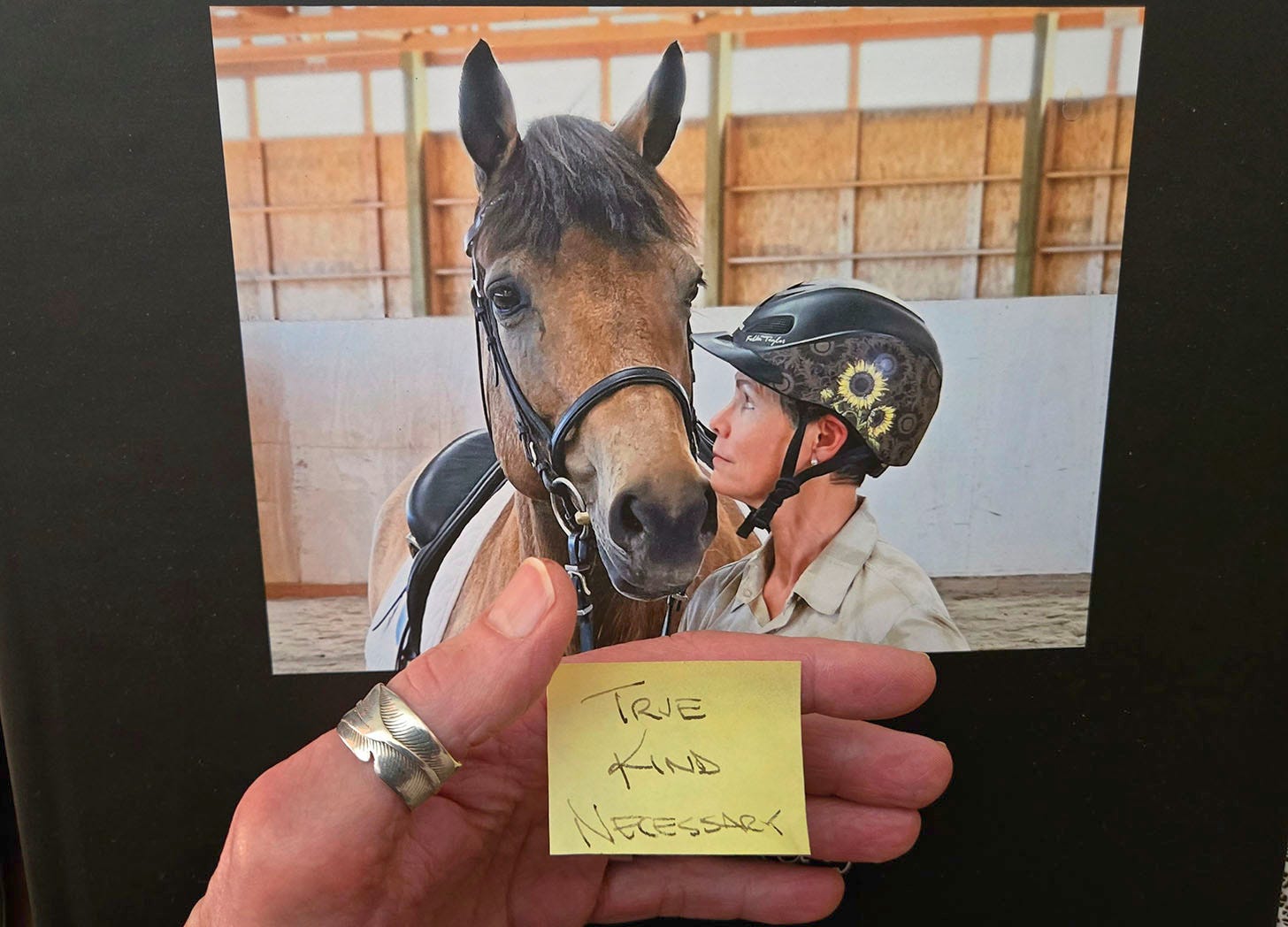
As I pondered this today, staring out at a morning bright with snow and clear sky, a faded yellow sticky-note on my desk caught my attention. TRUE KIND NECESSARY was printed in my backwards-slanting script. I haven’t noticed it in a while, and I’m not sure where I originally came across the idea of asking yourself if what you are about to say can fulfill the requirements of the above. (Are my words true? Are they kind? Are they necessary?) The idea is variously ascribed to the Buddha, or Ghandi, or Socrates, or an 1876 poem by the Quaker Mary Ann Pietzker.
No matter who came up with the notion or where I found it, I think TRUE-KIND-NECESSARY might just be my personal checklist for being impeccable with my words. And, if I go a little deeper, if I check in with the love-of-Katrina barometric pressure that has a distressing tendency to plummet, due to internal weather shifts brought on by both the realities of life and my old bad mental habits, then I might curb my quick tongue in favor of saying the impeccable words of love to myself, rather than snarling at the world in general.
Using this guideline, I probably will listen more and talk less. Which is never a bad thing.
May I speak blessings on my journey.
That said, if you like the writing and want to support horses, you might want to join our Prodigious Pledger Herd. Every dollar you pledge will go to support an organization that supports horses. We choose the organization in November and donate our hard-earned dollars in December of each year. You can check out my Substack About page for more information and to see a list of each year’s donations.
I love to hear from you, so feel free to give me a shout by clicking the “Message Katrina” button in the app or online. It might take some time, but I promise I will respond.
Thanks for being a Substack reader.
TO THE HORSE!
Well said! 💚🐴
Thank you!
I'll remember those 3 words and hope to be a better person 😇